How to tell whether your floor needs stripping, burnishing or a recoat
Choosing the wrong floor treatment costs you time and shine, so it helps to know what each one actually does.
October 20, 2026 · 4 min read
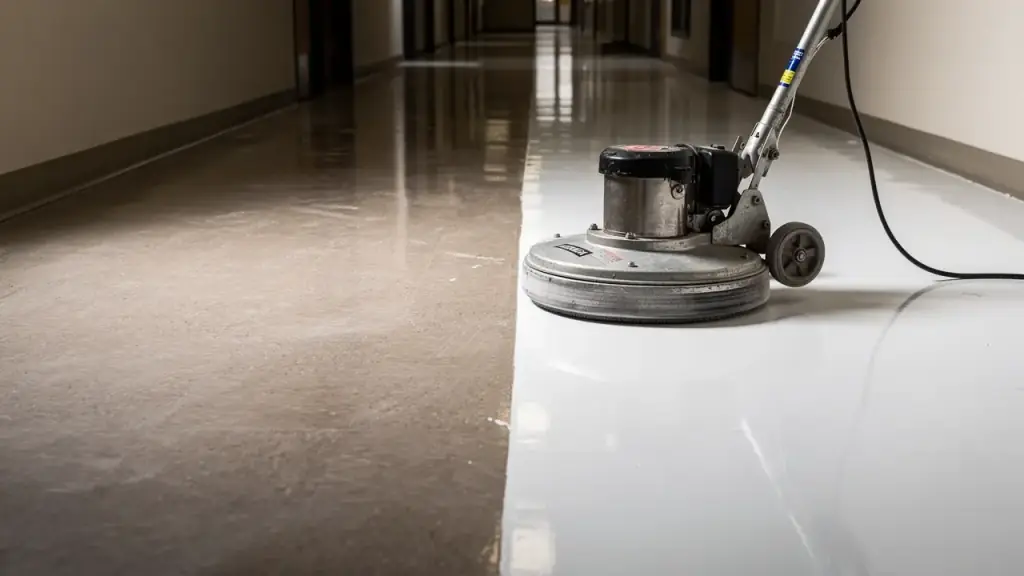
A floor can look worn out for very different reasons, and the fix for each one is different. A dull shine, yellow edges, black scuff marks and a peeling surface can all look like "the floor needs doing," but treating them the same way wastes effort. Understanding the difference between stripping, burnishing and recoating helps you ask the right questions and spot when a proposal makes sense for your floor.
Start with how a finished floor is built
Most commercial vinyl and VCT floors are protected by a layer of floor finish, the wax or polish you see as shine. Think of it like the clear coat on a car. The finish takes the foot traffic, the scuffs and the cleaning so the floor underneath stays intact. Over time that layer gets thinner in walking lanes and builds up in corners and along edges. Every treatment below is really a decision about what to do with that layer: polish it, add to it, or remove it and start again.
Burnishing: restoring shine on a sound finish
Burnishing means running a high-speed machine with a fine pad over the finish to bring back its gloss. It doesn't add material, it smooths and tightens what is already there. It works well when the finish is still thick and healthy but has gone dull from traffic. If a floor is clean, intact and just looks flat, burnishing is often the lightest option. It can't fix a finish that is thin, scratched through, yellowed or peeling, because there's nothing good left to polish.
Recoating: adding fresh protection
A recoat, sometimes called scrub and recoat, means cleaning the floor thoroughly and applying new coats of finish over the existing layer. It suits a floor where the finish is thinning in lanes but is otherwise even, with no heavy build-up and no yellowing. The new coats restore both shine and protection. The catch is that you can't keep recoating forever. Each recoat adds to the layer, and eventually that stack of old finish traps dirt, yellows and starts to look cloudy.
Stripping and waxing: a clean slate
Stripping removes every layer of old finish down to the bare floor. The floor is then rinsed, allowed to dry and given fresh coats. It's the biggest job of the three, and it's the right one when the old finish can't be saved.
- The finish has turned yellow or amber, especially along edges and in corners.
- There's visible build-up where the floor meets the wall or around fixtures.
- Black marks and scuffs stay even after a thorough clean.
- The finish is peeling, flaking or has worn through in patches.
- The floor has been recoated several times and now looks cloudy even when clean.
A simple test: clean a small patch properly and let it dry. If the shine comes back, burnishing or a recoat is likely enough. If it still looks dull, yellow or marked once it's clean, the finish itself is the problem and stripping is probably the answer.
Hardwood, tile and marble are different animals
Not every floor is vinyl, so don't assume the same method fits. Hardwood might have a waxed finish or a sealed one, and the two are cared for very differently. Water is hardwood's enemy, so heavy wet mopping is a risk, and the wrong product can damage the finish. Before any work starts, someone should confirm what's actually on the floor.
Tile and marble are usually polished rather than waxed. Marble in particular is sensitive to acidic cleaners, which can etch the surface and leave dull spots that look like water marks. Tile also has grout lines that hold dirt and need their own attention. The general rule for stone and tile is gentle, neutral cleaning for daily care and proper polishing when the surface has lost its gloss.
What to ask before you agree to a plan
Ask what type of floor you have and how they'd confirm it. Ask which of these treatments they recommend and why, what condition the finish is in, and what the floor will need to look like before and after: how long it needs to stay clear of traffic, and when it can be walked on again. A good provider answers in specifics and doesn't just offer one method for every floor.
Quality Clean handles floor stripping and waxing for hardwood and vinyl, as well as polishing for tile and marble and carpet cleaning or steaming. Their process starts with a free, no-obligation on-site assessment where they look at the floor and take measurements, so the quote matches your space. You can book one by calling 844-427-8254, Monday to Saturday, 8 to 5.
Quality Clean Maintenance and Services, 844-427-8254
Call 844-427-8254More articles
Keeping your office entrance and floors clean through a Fort St John winter
Most of the damage a winter does to a commercial floor happens in the first ten feet inside the door.
What to ask for when cleaning a dental office or medical clinic
A clinic's cleaner needs to understand what could spread between rooms, not just what looks dirty.